
Key takeaways:
- Rising out-of-pocket costs, higher deductibles, and increasing insurance expenses are creating financial strain for patients. Many Americans worry about affording care, and costs are projected to keep climbing.
- A significant share of patients postpone treatments, skip recommended care, or take on medical debt due to expenses. These financial challenges can worsen health outcomes and reduce access to needed services.
- Flexible financing programs, transparent cost estimates, consistent administration, and technology-enabled payment solutions can help patients manage healthcare expenses while supporting provider revenue and strengthening patient relationships.
The affordability of healthcare has been a prominent issue for many years. It’s an increasingly urgent concern for both patients and their providers. As one long-time industry observer commented, “Today, what matters most to consumers is whether a needed service is accessible and affordable, and what their out-of-pocket responsibility will be.”[1] footnote [1] A respected association’s analysis warned that the healthcare system is “not making progress toward improving affordability” and could slip into “crisis mode.”[2] footnote [2]
Affordability problems threaten patient health, provider finances and equitable access to care. This report examines recent data that illustrate the extent and complexity of the issue. The essential features of a comprehensive approach to patient financing that can help many patients are also discussed.
The current state of affordability.
The overall landscape.
Healthcare costs are multifaceted, and a high proportion of Americans have trepidation about all of them (Figure 1).[3] footnote [3]
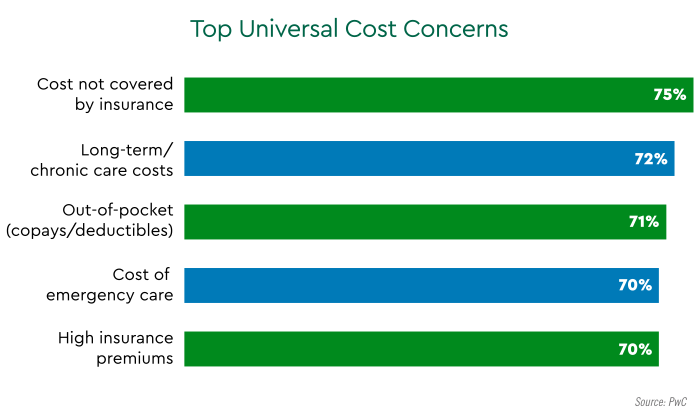
Figure 1
Figure 1 Text-Friendly Version PDF opens in a new window[PDF]
In a nationwide poll, 32% of respondents said they’re very worried about being able to afford healthcare, and another 34% are somewhat worried.[4] footnote [4] Fifty-six percent of adults over age 50 remain “very concerned” about the cost of medical care. [5] footnote [5] These worries are well-founded: A Federal Reserve study showed that 21% of adults reported at least one significant unexpected medical expense in the past year.[6] footnote [6]
Specific numbers illuminate the challenges.
Various recent surveys have quantified the growing financial burden of healthcare costs.
Affordability Challenges
- Individual out-of-pocket expenditures are projected to increase 3.7% in 2026 and 2027 and 3.9% yearly from 2028 to 2033.[7] footnote [7]
- National health expenditures will grow at a faster pace than gross domestic product through 2033.[8] footnote [8]
- Between 2020 and 2025, the average employee contribution for employer family coverage rose 23%.[9] footnote [9]
- Individual plans carrying deductibles of $2,000 or more are held by 34% of workers.[10] footnote [10]
Forecasts suggest that affordability stress will extend into the future. Demographics are a clear factor. By 2033, there will be 16 million middle-income seniors over age 75.[11] footnote [11] This cohort typically doesn’t qualify for Medicaid while often having insufficient financial resources for healthcare. Fifty-four percent will have three or more chronic conditions.
A note on healthcare employees.
It’s worth noting that health systems, hospitals and practices confront general affordability issues not just with patients, but with their employees as well. One leader counsels healthcare organizations to “expand their focus on affordability for team members and their families in order to recruit and retain talent in the communities they serve.”[12] footnote [12]
Patient responses.
How are patients dealing with affordability challenges? For some, avoiding or delaying needed care is the unfortunate solution. Over one in four surveyed adults have postponed surgical or medical treatment sometime over the past four years due to cost.[13] footnote [13] In late 2025, 29% of polled individuals said cost concerns prompted them to skip or delay some recommended care during the previous 12 months.[14] footnote [14] That figure jumped to 38% for Medicaid recipients and 41% for the uninsured.
Those who proceed with acute care must frequently contend with finding the means to satisfy upfront payments. Advance payments are a growing trend. Hospitals collected 30% of what patients owed in the first quarter of 2026 at point of service.[15] footnote [15] Patients also struggle to pay their full obligation. One analysis showed that providers collected nearly 48% of total patient obligation, with the rate declining noticeably as amounts owed increase (Figure 3).[16] footnote [16]
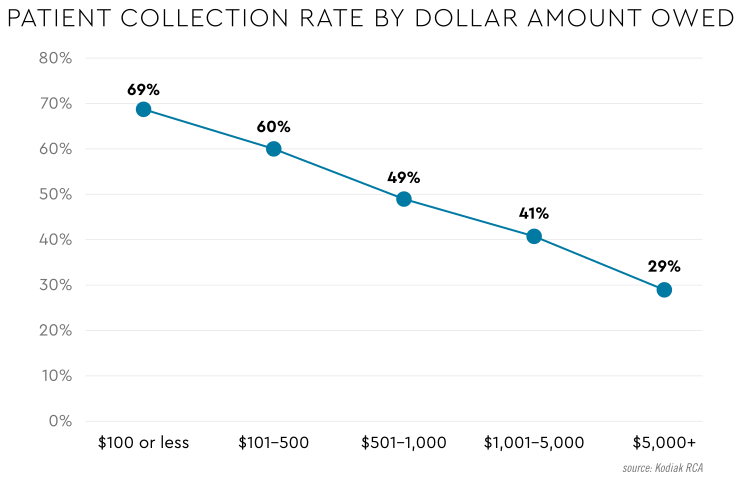
Figure 2
Figure 2 Text-Friendly Version PDF opens in a new window[PDF]
Many patients rely on some form of debt to meet their self-pay obligations. Previous estimates placed the total medical debt incurred in a 12-month period at $74 billion, carried by 31 million Americans.[17] footnote [17] Almost six in ten of these healthcare borrowers assumed debt of $500 or more, and the median amount borrowed by patients 50 and older was $3,000.[18] footnote [18]
The debt burden represents another barrier to obtaining health services. One-third of people with medical debt deferred care in the prior 12 months, due to cost — more than six times the rate of those without medical debt.[19] footnote [19]
To provide some relief, credit reporting agencies have voluntarily instituted policies that remove many aspects of medical debt from consumer credit reports. Amounts under $500 are excluded as is debt outstanding for under one year.
What about insurance?
Health insurance is a vital element in the financial equation. However, several problems make it a less than complete solution to patient affordability. A barrier for some is lack of coverage. By 2034, the overall uninsured rate in the U.S. is expected to rise to 8.9% from 7.7% currently.[20] footnote [20] Coverage gaps are even more pronounced for certain secondary care. For instance, 26% of adults lack dental insurance — one-third of those over age 60.[21] footnote [21] These levels add to overall cost burdens.
Federal cutbacks in eligibility for Medicaid benefits and in subsidies for purchasing insurance on the Affordable Care Act (ACA) exchanges threaten to reduce or eliminate coverage for many with limited financial resources. Medicaid could see a reduction of 7.6 million Medicaid enrollees over the 2025–2034 period.[22] footnote [22] Scenario analysis of cuts to states that expanded Medicaid rolls in recent years projects anywhere from 4.9 to 10.1 million fewer individuals in 2028.[23] footnote [23]
The ACA numbers are likewise of great financial concern:
- Total average monthly paid enrollment for 2026 could decline by six to seven million people.
- Premium payments rose an average of 58% from $113 to $178 per month.
- Average 2026 deductibles increased by 37% to a record high of $3,786.
It’s not only the subsidized enrollees who are exiting ACA. Consumers at 400–500% of poverty levels were ineligible for subsidies. They represented 3% of 2025 plan selections but 27% of the 2026 decline in dropped coverage.
Health insurance is often confusing and difficult to navigate. That can exacerbate financial stress. In a survey on barriers, 45% of respondents stated that they struggle to understand their insurance. In another poll, 56% rated their knowledge of health insurance as low to moderate.
Yet another source of consternation for patients and institutions alike is heavy use by insurers of prior authorization and initial claims denials. Recently, 34% of insureds named prior authorization as their single biggest healthcare burden beyond costs.
Tackling affordability through comprehensive patient financing.
While complete solutions to the affordability problem involve larger considerations of public policy and healthcare market structure, greatly enhanced provider financial assistance to patients can play a central and immediate role. Though market scans suggest generally wide adoption of at least basic hospital-administered payment plans, financing needs expansion to meet today’s burgeoning challenges.
CommerceHealthcare® has partnered extensively with health systems, hospitals and practices on patient financing. This experience has shown that programs attain comprehensiveness and versatility when they combine five core characteristics.
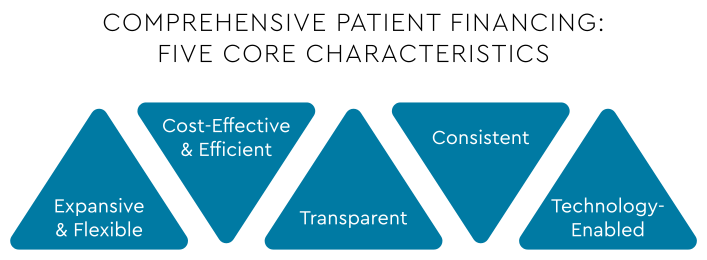
Figure 3
Figure 3 Text-Friendly Version PDF opens in a new window[PDF]
Expansive and flexible.
Financing should be tailored to individual patient requirements. That objective is well-served through a program featuring low or zero interest rate lines of credit for amounts up to $50,000. This credit line approach enables patients to cover any subsequent care charges they might incur without new loan origination.
The solution maximizes scope and flexibility of assistance. Organizations may combine direct in-house financing for smaller dollar amounts with bank financing for obligations ranging from $1,000 up to $50,000. Another advantage is that patients avoid high credit card interest charges. Nearly one in six uses a credit card for every healthcare encounter.[28] footnote [28] About one in eight carries credit card debt from medical bills.[29] footnote [29]
Cost-effective and efficient.
Patients desire a convenient and efficient process, and providers seek to save internal staff time and expense. A recourse-based credit line financing program through a bank features approval with no credit check in most cases. The provider is relieved of the burden of screening and selecting patients to be referred for the financing. The right bank administering the program should bring skill and diligence to execution to ensure that cost and convenience goals are met.
Transparent.
Despite various implementation barriers, healthcare continues working toward greater transparency regarding costs of care. Patients have shown a desire for such information, particularly in advance of service. About 45% now receive a cost estimate before care.[30] footnote [30] Most say the estimated charges were accurate, though 26% found the actual cost to be “much more” than the estimate.
A comprehensive program will include offering financing based on the estimated charges, which can alleviate patient concerns up front. A previous study determined that under half of hospitals permitted patients to qualify for financial assistance prior to care.[31] footnote [31]
Consistent.
Many organizations find it challenging to conduct patient financing in a consistent manner. Coordination between multiple departments is required, and frequent variation in patient-facing skills exists among employees. Outsourcing to an external vendor that brings disciplined loan administration and experienced patient relations offers much-needed consistency that is essential to scaling a comprehensive program. The vendor can also provide scripts and other tools for internal staff to help maintain a consistent approach.
Technology-enabled.
Patient financing is optimized when it rests on a strong technology foundation. Important elements include integration with core financial systems, support for mobile devices, payment process automation software, and use of digital payments.
As one example of deploying this synergistic mix, consider patient refunds. It’s highly likely that total refunds have grown since the estimated level of $3.1 billion in 2022, given greater use of preservice estimates and upfront payments.[32] footnote [32] Solutions like PreferPay® from CommerceHealthcare® manage the refund cycle, interfacing with provider systems, gathering patient information through mobile devices, and offering a choice of refund modes: direct deposit, direct to debit card, e-check, or paper check.
Emerging near-realtime price transparency technology promises a quantum leap in cost visibility. Artificial intelligence and automated data integration enable payers and providers to make rapid insurance coverage determinations to calculate actual cost and patient obligation.
Patient loyalty: an added benefit.
Not only does the financing approach outlined in this report address the prevalent affordability hardships, it also fosters positive patient relationships and loyalty. It’s been calculated that a loyal patient, defined as one who spends 75% or more of the individual’s healthcare expenses with one health system over a given time frame, generates three times more revenue than an uncommitted patient.[33] footnote [33]
Conclusion.
Finding ways to help all patients secure the care they need is a vital and urgent goal. Building a robust and comprehensive patient financing platform deserves to be a key part of every organization’s strategy. An alliance with a strong bank adds the experience and resources required to onboard such a program. The benefits for patients and their providers can be substantial.
CommerceHealthcare® solutions are provided by Commerce Bank.
[1]P. Keckley, “Private Equity Ownership of Hospitals: A Reality Check,” Modern Healthcare, February 2025.
[2]Healthcare Financial Management Association and Vitalic Health, “U.S. Healthcare Vitals Tracker,” September 2025.
[3]PwC, The Consumer-First Era of Health, October 2025.
[4]Peterson-KFF, “Eight Trends Shaping 2026 Healthcare Costs,” March 17, 2026.
[5]University of Michigan Institute for Healthcare Policy and Innovation, “On Their Minds: Older Adults’ Top Health-Related Concerns,” May/June 2024.
[6]The Federal Reserve, Economic Well-Being of U.S. Households in 2025, May 2026.
[7]S. Keehan, A. Madison, J. Poisal, et al., “National Health Expenditure Projections, 2024–33: Despite Insurance Coverage Declines, Health To Grow As Share Of GDP,” Health Affairs, July 2025.
[8]Ibid.
[9]KFF, 2025 Employer Health Benefits Survey, October 22, 2025.
[10]Ibid.
[11]NORC at the University of Chicago, The Forgotten Middle: Housing & Care Options for Middle-Income Seniors in 2033, August 31, 2022.
[12]K. Gooch, M. Ashley, K. Kuchno, and A. Condon, “10 Trends for CHROs to Watch in 2025,” Becker’s Hospital Review, February 27, 2025.
[13] West Health, “One-Third of Americans Making Financial Trade-Offs to Pay for Healthcare,” March 12, 2026.
[14]PwC, 2025 U.S. Healthcare Consumer Insights Survey, October 2025.
[15]P. Barr, “Patient POS Collections Pose a Growing Problem for RCM Departments,” HFMA Magazine, June 8, 2026.
[16]Kodiak, “Drawing the Line on Patient Responsibility Collection Rates,” February 2024.
[17]Gallup, “Americans Borrow Estimated $74 Billion for Medical Bills in 2024,” March 5, 2025.
[18]Ibid.
[19]K. Moon, N. Becker, K. Miller, and C. Ettman, “Medical Debt and Deferred Care for Physical Health, Mental Health, and Dental Needs Among U.S. Adults,” Journal of General Internal Medicine, March 10, 2026.
[20]J. Hale, N. Hong, B. Hopkins, et. al., “Health Insurance Coverage Projections for the U.S. Population and Sources of Coverage, by Age, 2024-34,” Health Affairs, July 2024.
[21]CareQuest Institute for Oral Health, State of Oral Health in America: Key Survey Findings, November 2025.
[22]RAND Corporation, State-Level Impacts of Key Medicaid Provisions in the One Big Beautiful Bill Act, February 26, 2026.
[23]Urban Institute and Robert Wood Johnson Foundation, Projected Reductions in Medicaid Expansion Enrollment Under OBBBA’s Work Requirements and Six-Month Redeterminations, March 2026.
[24]KFF, “What We Know So Far About 2026 ACA Marketplace Enrollment, Premiums, and Deductibles,” May 19, 2026.
[25]PhRMA and Ipsos, Access Denied: Patients Speak Out on Insurance Barriers and the Need for Policy Change, October 2024.
[26]Corporate Insight, Health Insurance Literacy Study, January 2025.
[27]KFF, “Are the Tradeoffs from Prior Authorization Worth It?” March 16, 2026.
[28]Harmonyhit.com, “Report: 1 in 3 Americans Plan to Skip Doctor Appointments to Save Money in 2025,” September 25, 2024.
[29]Bankrate, Bankrate’s 2026 Credit Card Debt Report, January 2026.
[30]Experian Health, The State of Patient Access - 2026, March 2026.
[31]S. Randall, J. Rohrer, N. Wong, N. Nguyen, E. Trish, and E. Duffy, “Financial Assistance and Payment Plans for Underinsured Patients Shopping for ‘Shoppable’ Hospital Services,” Health Affairs Scholar, May 10, 2024.
[32]Aite-Novarica, U.S. Patient Refunds: A Market Sizing, November 27, 2019.
[33]Vizient and Kaufman Hall, “2025 Trends Report: Strategy is (Finally) Back in the Driver’s Seat,” December 12, 2024.