
Key takeaways:
- Financial pressures are driving the need for stronger remittance automation as rising costs and declining reimbursements make manual workflows unsustainable.
- Labor-intensive tasks and fragmented systems remain the biggest barriers to achieving efficient, scalable remittance automation.
- A gold-standard solution like RemitConnect® from CommerceHealthcare® can streamline posting and reconciliation to improve cash flow, accuracy and workforce productivity.
Optimized workflows in healthcare receivables management remain an elusive goal as hospitals, health systems and practices continue to focus heavily on cost savings and productivity gains. Efficient processes are also central to successful management of the value-based reimbursement models gathering industry momentum.
This CommerceHealthcare® Solutions Perspective briefly examines typical remittance automation barriers, defines the characteristics that comprise an automation “gold standard,” and describes how Commerce’s solutions meet the standard.
Key issues.
Today’s financial landscape is certainly challenging. Total hospital expenses increased at twice the rate of prices in 2025, and costs for labor and supplies rose almost 6% and 10%, respectively.footnote [1] Likewise, revenue pressures are mounting due to projected cutbacks in Medicaid, Affordable Care Act enrollment declines, and other reduced insurance reimbursements. Over 80% of CFOs now view business conditions as their primary concern.footnote [2] Eighty-four percent of surveyed administrative and clinical leaders named financial pressures as their greatest threat for the coming year.footnote [3]
This environment mandates high-performing revenue cycle management (RCM), with automation of the core remittance process an increasing necessity. However, two prominent hindrances to more robust automation exist in the receivables area:
- Labor-intensive processes. Manual steps still burden the remittance process. The Council for Affordable Quality Healthcare (CAQH) calculates that full automation of several high-volume administrative transactions would save healthcare almost $19 billion.footnote [4] Savings would result from a widening cost gap between electronic and manual processing of over $5.00 per transaction.footnote [5] As one example of labor intensity, over 20% of claims payments are executed manually, and CAQH suggests automation could bring a three-minute time saving to each one.footnote [6]
- Process complexity and disparate systems. Remittance management faces a host of process and organizational complexities, which automation solutions must take into account. Multiple payment modes are involved, as are several different departments, often following different workflows. The revenue cycle also relies on a variety of financial, EHR and patient management systems that are frequently non-integrated, creating workflow complexity and forcing manual splitting and posting of aggregated remittances.
Maintaining these manual, complex processes is both costly and increasingly difficult in the face of persistent workforce shortages in RCM and IT. In response, 58% of organizations recently said they have turned to outsourcing in both areas.footnote [7]
To overcome the hurdles, providers have pursued remittance automation with varying success. It is not uncommon for remittance staff to access 20 or more payer websites, only to download paper forms for completion. Such scenarios help explain why many RCM executives express frustration with their automation progress and lack confidence in their revenue capture results (Figure 1).footnote [8]
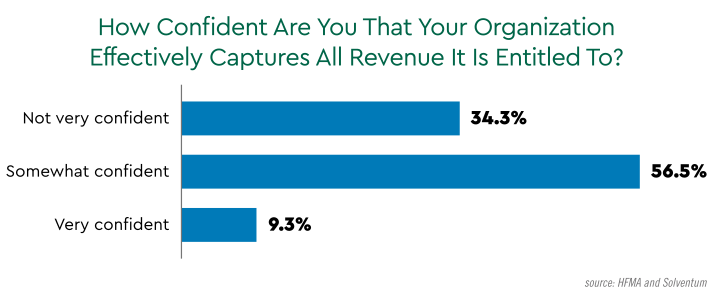
Figure 1
View PDF of Figure 1 opens in a new windowPDF
The CommerceHealthcare® solution.
What does the right automation entail? Organizations must evaluate remittance automation investments through the lens of a “gold standard.” RemitConnect® from CommerceHealthcare® automates the entire posting and reconciliation process for insurance and patient receivables, reducing complexity caused by variable payment formats. It adheres to the essential gold standard requirements by offering several key features:
- A single unified system. RemitConnect® is a unified technology/services platform that integrates with revenue systems and establishes one centralized hub for all payments processing.
- Comprehensive process automation. RemitConnect® goes “all in” to prevent automation leakage with end-to-end coverage (Figure 2):
- Proactively working toward 100% EFT for every remit claim.
- Automatic unbundling of co-mingled payments.
- Automatic reconciliation of payments and claims, with correspondence and denials routed using paperless workflows.
- Automatic posting to the appropriate financial system.
- System-generated management reporting and audit trails.
- Online portal for searchable documents and transmission of indexed image files to the provider’s document image management system.

Figure 2
- Experienced people support. Dedicated enrollment and account teams staffed by professionals who understand healthcare banking and payer processes.
Full optimization yields major benefits.
Pursuing a “gold standard” rather than accepting workarounds or partial automation unleashes significant benefits:
- Maximizes cost savings and cash flow. Reduces manual processing costs while accelerating cash application and improving visibility into receivables.
- Optimizes workflow. Paperless automation speeds overall process and improves accuracy to deliver ROI and sustainable long-term gains.
- Heightens workforce productivity. The comprehensive automation of RemitConnect® enables exception-based workflow, so staff can focus on non-routine cases. Automation also supports efficiency for staff working remotely.
- Supports value-based care. Efficient processes are foundational to managing value-based reimbursement.
- Advances digital transformation efforts. Establishes a scalable, integrated foundation that aligns receivables with broader digital and automation strategies.
Pave the way to success with a Payment Cycle Review.
For those providers who would like to pinpoint their receivables workflow needs to prepare for automation, CommerceHealthcare® offers a Payment Cycle Review. The bank’s professionals quickly gather and analyze internal information, identify or confirm opportunities for improvement, and recommend specific process changes to help maximize the automation strategy.
Conclusion.
The “gold standard” requirements for remittance automation are clear, value-generating and achievable. RemitConnect® conforms to these requirements and deserves consideration as a core automation solution.

Peer Reviewed by HFMA®
Following a rigorous review, RemitConnect® has the distinct honor of earning the "Peer Reviewed by HFMA®" designation. The award reflects the value RemitConnect® delivers healthcare providers by streamlining the receivables posting and reconciliation process. The solution was recognized for increasing cash flow, reducing financial risks and helping avoid unnecessary adjustment and patient refunds.
CommerceHealthcare® solutions are provided by Commerce Bank and powered by MediStreams.
Disclosures:
[1]American Hospital Association, “Costs of Caring,” March 11, 2026.
[2]Deloitte, “How Health Care CFOs Can Adapt to Emerging Industry Conditions,” June 24, 2025.
[3]McKinsey & Company, Seizing the Agentic AI Advantage, June 2025.
[4] CAQH, 2025 CAQH Index, February 19, 2026.
[5]Ibid.
[6]CAQH, 2024 CAQH Index, February 12, 2025.
[7]Kaufman Hall, “2025 Health System Performance Outlook,” December 2025.
[8]Healthcare Financial Management Association, “Automation and AI in Revenue Cycle Research,” May 2025.