
The three “rights” of remittance automation.
Key takeaways:
- Manual work and complexity slow remittance processes as high volumes of paper, varied payment types and siloed workflows create inefficiencies and delays.
- End-to-end automation improves accuracy and efficiency by converting paper to digital, automating reconciliation and posting, and strengthening reporting and integration.
- Strong people and modern platforms drive long-term value through payer enrollment, ongoing monitoring and future-ready tools like AI and digital payments.
Health systems, hospitals and practices continue to face a highly challenging financial landscape. Total hospital expenses increased at double the growth rate of prices in 2025, with labor and supply costs up almost 6% and 10%, respectively.footnote [1] At the same time, revenue pressures are mounting from healthcare’s rapidly shifting reimbursement models. With these trends showing few signs of abating, it’s not surprising that more than 80% of CFOs see business conditions as their primary concern.footnote [2] Eighty-four percent of surveyed administrative and clinical leaders named financial pressures as their greatest threat for the coming year.footnote [3]
Cost control is a priority in this environment, and automation of administrative and financial processes occupies an important chapter in the playbook. Healthcare payments offer fertile ground for automation. This report explores a proven approach in remittance management, one that generates efficiencies, reduces costs to collect, promotes digital strategies, and prepares the organization for the future.
The report focuses on the three essential “rights” of a comprehensive solution: functionality, people, and technology platform (Figure 1).
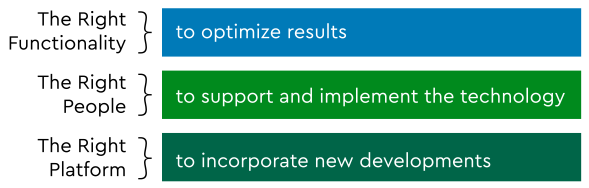
Figure 1
View PDF of Figure 1 opens in a new windowPDF
Current issues in remittance management.
Taking the pulse of current conditions in the remittance area helps set the baseline for evaluating the right solution. Despite progress in revenue cycle management (RCM) automation in recent years, healthcare finance leaders continue to see significant inefficiencies that they wish to eradicate. Remittance management is a promising target. Two strong drivers justify the push for greater automation.
Substantial manual activity.
The high-volume administrative transactions monitored by the respected Council for Affordable Quality Healthcare (CAQH) increased in quantity by 10% in 2025.footnote [4] The prevalence of manual processes is evident in the organization’s calculation that full automation of these transactions would save healthcare almost $19 billion. Those savings are fueled by a widening cost gap between electronic and manual processing that reached over $5.00 per transaction in 2025 (Figure 2).footnote [5]
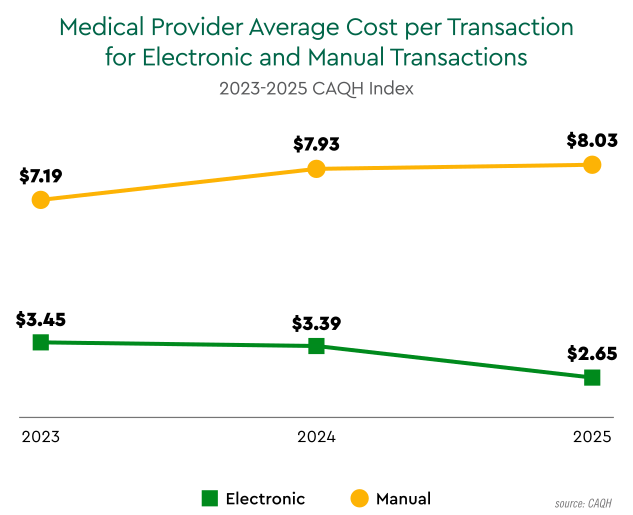
Figure 2
View PDF of Figure 2 opens in a new windowPDF
Two categories tracked by the CAQH serve to highlight the considerable manual effort still expended in remittance management:
- Claims payments. More than one in five transactions — equating to 389 million — are executed manually. Automation could bring a three-minute time savings to each one.footnote [6]
- Remittance advices. Thirteen percent were fully or partially manual in 2025, an increase from the prior year.footnote [7] A four-minute transactional time savings is calculated.
Persistent complexity.
Remittance management faces a host of process and organizational complexities that automation solutions must take into account (Figure 3).
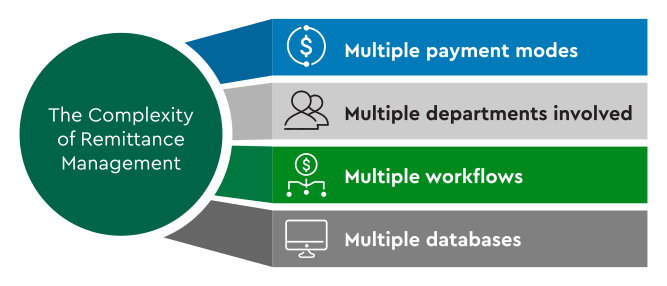
Figure 3
View PDF of Figure 3 opens in a new windowPDF
Multiple payments modes and inputs.
Providers receive payments and associated information in different ways: paper checks and EOBs, electronic payments and advices (ACH and 835), and credit cards. Payments can originate from various locations: online portals, points of service, and virtual health encounters. Most payments stem from insurance reimbursement, but an increasing layer of complexity derives from growing transactions directly with patients.
Health systems saw the self-pay component of out-of-pocket payments increase by 11% between February 2023 and September 2025.footnote [8] Further growth is expected as employer high-deductible health plans expand and more payments responsibility is pushed to patients.
Diverse departments involved.
The reimbursement cycle is typically handled by multiple departments within finance and RCM. Often, these departments are fairly siloed. That limits direct interaction and creates chances for slippage, delays, and other issues. This concern is common across industries. A broad survey recently found that 30% of executives cited organizational silos as a primary barrier to addressing stagnant productivity.footnote [9]
Various workflows.
Each involved department may have steps and policies that don’t align neatly with those of their counterparts. Even within groups, deviations from prescribed workflows occur for various reasons. The lack of uniformity and coordination makes it difficult to implement extensive change. As a health system revenue cycle director stated, “Scalability is inherent to consistent workflows. Without consistent processes, scalability is next to impossible.”footnote [10]
Multiple accounting and billing systems.
Many legacy systems remain in use in healthcare. Often, they’re difficult to interface with those that are more modern. In addition, organizations frequently find themselves with an IT landscape populated by disparate systems as a result of mergers. The typical result is costly redundancy and limitations on ease of data sharing.
It can take years for in-house teams to rationalize not only the technology but also the corporate accounts. As an example of the magnitude organizations can confront, CommerceHealthcare® worked with one post-merger client to reduce 47 different lockboxes and accounts to seven.
Additional complexity factors.
A number of strong macro trends are exacerbating process complexity and complicating automation efforts:
- Workforce shortages. The staffing shortfalls in RCM and IT have been well documented. In fact, 58% of organizations recently said they have turned to outsourcing in both areas in response.footnote [11]
- New reimbursement models. Remittance management is adapting to many changes. The forthcoming cutbacks to Medicaid and other government programs will have a significant impact. Value-based care reimbursement as a replacement for fee-for-service is also gaining momentum, and 17% of hospitals plan to use this reimbursement type as one of their financial success strategies.footnote [12] Other reimbursement programs that will need management include direct contracting with corporations.
- Continued industry consolidation and site-of-care expansion. Providers will continue to pursue growth and diversification through M&A, alliances, and expansion of ambulatory services. As one data point, the latest HealthLeaders Intelligence survey showed that 90% of hospitals expect to complete or explore M&A deals over the next 18 months.footnote [13] These expansion trends likely guarantee that organizational complexity remains a significant factor.
Three “rights” to seek in an automation solution.
Responding to the array of remittance management challenges requires a comprehensive, flexible, easy-to-implement automation solution that maximizes cost savings and staff productivity gains. Leaders today want to avoid partial or weakly implemented solutions.
What should guide decision making?
CommerceHealthcare® has experience with hundreds of hospitals and practices which demonstrates that organizations need to seek three “right” components.
The right functionality.
Streamlined, consistent remittance management depends on automation occurring at each major step in the process (Figure 4).

Figure 4
View PDF of Figure 4 opens in a new windowPDF
Specific core functionality should be prioritized:
Manage all payments types and convert paper.
The right solution handles the diversity of payer and patient payments and related informational advices. Paper remittances are converted into digital 835 posting format. A fully digital transaction flow is the goal.
File disaggregation.
Payers typically issue multiple payments bundled into one file. Automation system intelligence performs “file splitting” to produce appropriate separate ERAs with retention of all information. The algorithms must address complexities to achieve accuracy. As one example, a doctor has a single NPI number, but may practice in the hospital ER, in a private practice, and at another care site. The software needs to be able to distinguish the proper payments scenarios. The inherent fragmentation of healthcare makes such situations fairly common. An analytics firm observes that “the system was designed around providers,” and is characterized by “a complicated web of systems and structures.”footnote [14]
Automated reconciliation.
Automatic and seamless system-matching of payments and remittance advices is fundamental to producing time savings in an activity that frequently involves considerable manual effort. Automatic reconciliation also limits human error to promote high accuracy and compliance.
Automated posting.
Once unbundled, data for each payment should be automatically routed to the appropriate patient accounting system. Initial setup of the routing protocols within the system can be time-consuming, and already-burdened internal IT departments often struggle with executing the analysis and programming. The right solutions vendor will perform the required research and system setup to alleviate the internal resource constraints.
Reporting and auditing.
Strong reporting capability is critical to support financial management, governance and analytics. System-generated reports and tracking should cover enrollment, correspondence, payments status and other core metrics at both detail and summary levels (see examples in Figures 5 and 6).

Figure 5
View PDF of Figure 5 opens in a new windowPDF
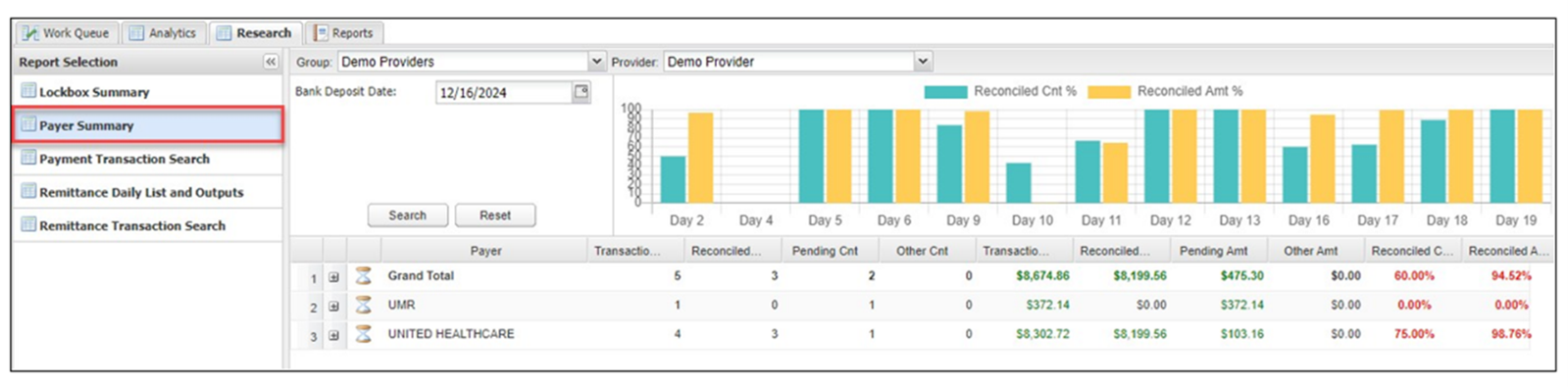
Figure 6
View PDF of Figure 6 opens in a new windowPDF
Views across a range of time periods should be available along with daily activity visibility such as shown in Figure 7. Coverage should include challenging activities such as provider-level balances, payer takebacks, interest payments and other adjustments uncorrelated with individual patient accounts.
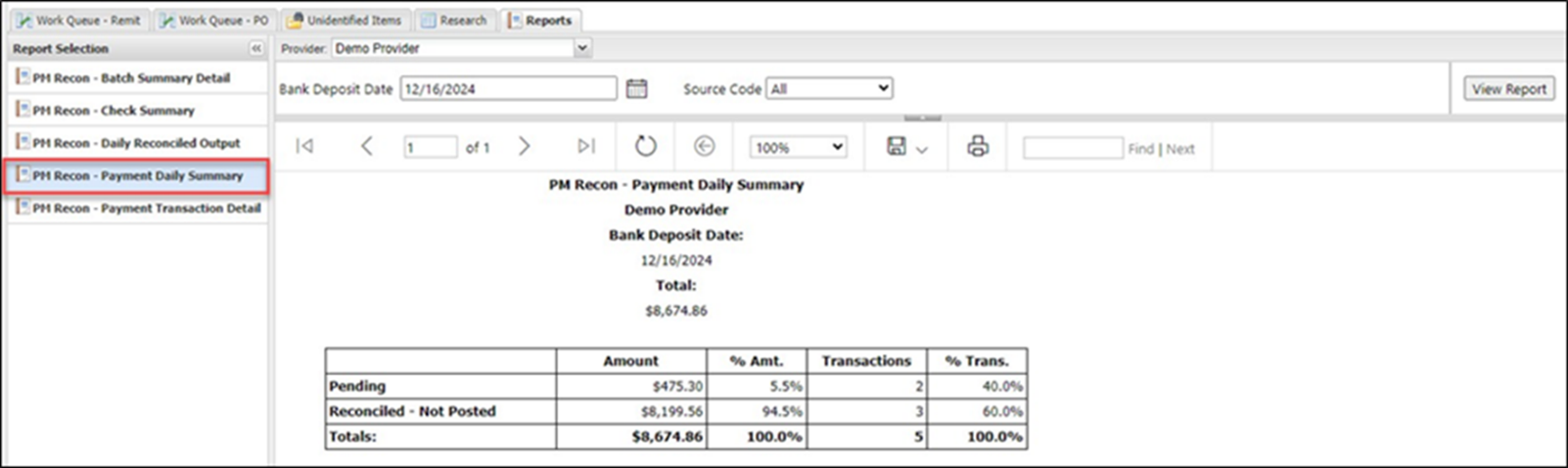
Figure 7
View PDF of Figure 7 opens in a new windowPDF
Flexibility and utility are maximized when system reporting tools are readily configurable to an organization’s needs. Multi-year data archiving is likewise a critical feature to support auditing and feeding the rapidly improving analytics tools available to financial executives.
Additional features to seek.
Beyond core process functionality, several additional features are vital and should be sought as part of the right solution:
- Correspondence management. The remittance process generates considerable daily volume of paper and electronic correspondence from payers on a variety of issues such as denials and information requests. Responding is still heavily manual, time-consuming, and error-prone. Research is often required to formulate the response. Crucial remittance automation functionality encompasses: (a) accurate capture from letter-formatted documents of patient information, document types, and other data, (b) proper categorization and prioritization of time-sensitive documents, and (c) efficient storage of all payer correspondence using advanced indexing techniques to support quick search and workflow automation.
- User interface. User experience is important. A web portal is a convenient user gateway that allows single sign-on access to a secure, centrally located remittance automation system containing readily searchable documents. Configurability by user promotes usage and productivity.
- Integration. System integrations enable effective data sharing and seamless execution of routing protocols. Remittance automation systems can be interfaced with patient accounting, document management, electronic medical records, and other enterprise-wide systems. A valuable remittance solution option is the ability to generate index files for images to support integration with provider image repositories (Figure 8). Integration best practices call for use of application programming interfaces (APIs), though file transfer modes still need to be accommodated where legacy architectures are in place.
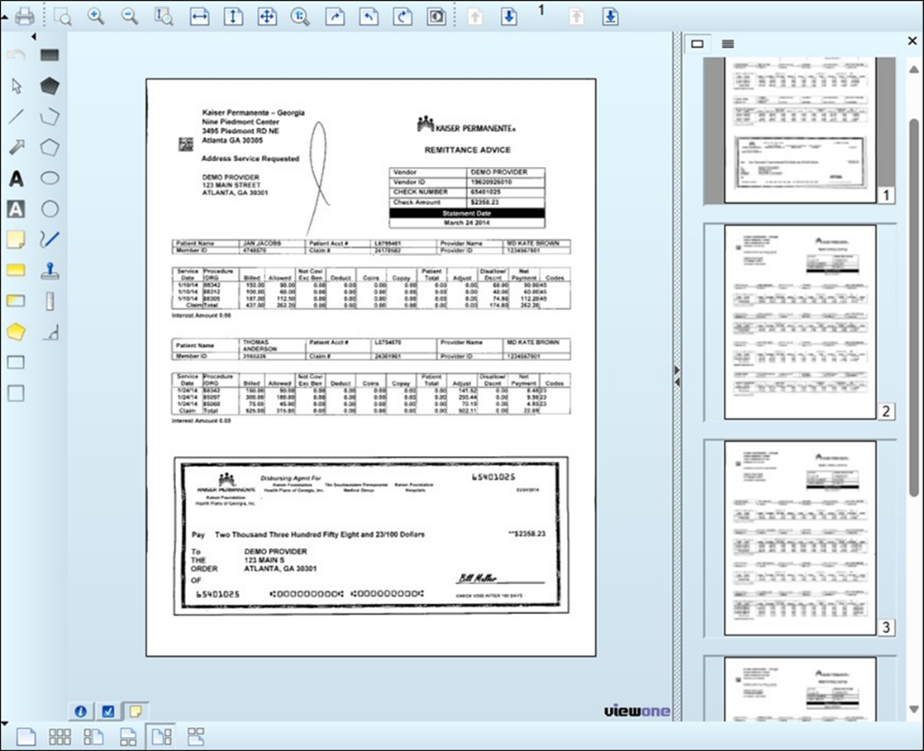
Figure 8
View PDF of Figure 8 opens in a new windowPDF
The right people.
The vendor selection equation has another important variable: the people supporting the solution. A fundamental prerequisite is significant healthcare experience on the part of the implementation and account management teams. This brings an understanding of financial workflows and the complexities involved. CommerceHealthcare®, for example, insists that its team members obtain the Certified Revenue Cycle Representative designation from HFMA.
Skilled vendor professionals positively impact several crucial aspects of remittance automation:
- Diligent payer enrollment. One of the critical success factors in remittance automation is comprehensive payer enrollment onto the platform. Complete coverage maximizes electronic payments. The task requires discipline. For each payer, vendor implementation experts will obtain the provider’s designated clearinghouse and acceptable payments file formats. They will then ensure that all information is accurately entered into the automation system.
- Ongoing surveillance. RCM isn’t a static process. Once initial enrollment is complete, it’s vital to conduct active monitoring for changes and updates to payer processing. New sources of paper checks, address changes, conversion of payments methods — these and other issues can cause automation leakage over time if not addressed. Look for vendor teams dedicated to the account and carrying a mandate to maintain consistent diligence.
- Reporting. It’s helpful and efficient for the solution’s account management team to examine the system’s report output, use the analysis tools, and proactively review the findings with internal RCM staff.
- Advisory. Diligent monitoring often produces insights for staff usage of system functions as well as beneficial workflow redesigns.
The right platform for the future.
Technology’s rapid advances are driving transformation in many aspects of healthcare. The third “right” for remittance automation embraces this trend. A solution must satisfy today’s requirements while simultaneously offering a foundation for harnessing forthcoming technological developments in payments. Two prominent ones are on the horizon.
Artificial intelligence.
This powerful technology will increasingly be layered into remittance automation to power functionality.
- Analysis of volumes of data to create workflow thresholds that automatically signal when human review of a remittance is needed to route the case to the appropriate individual.
- Intelligent extraction of data from correspondence to streamline research and trigger required actions.
- Insight generation from the ongoing remittance process to enable continuous improvement.
The right platform will assist providers in reaping the benefits of AI in payments without significant internal development. Industry observers expect that many provider organizations will adopt AI in significant measure through vendor enhancement of existing software.
Digital payments.
Electronic funds transfer (EFT) is an important vehicle for payer remittances to providers, but same-day and other digital payments rails are emerging as alternatives. These modes are gaining impetus from both payer adoption and interest among patients who increasingly expect more choice in payment methods. Healthcare’s adoption of digital payments globally is predicted to grow annually at nearly 21% to become a market of $96.5 billion by 2034.footnote [15] So-called payments orchestration platforms that intelligently manage near-real-time payments routing and execution are growing 18.6% annually, with healthcare being one of the fastest-growing segments.footnote [16]
What the “rights” deliver.
Selecting the right solution delivers multiple benefits:
- Productivity and efficiency. Automation creates an exception-based process that reduces repetitive time-consuming work. One example is lockbox processing. System conversion of EOBs and other paper documents to electronic files coupled with vendor management relieves provider staff of tedious activity associated with traditional lockboxes. Automation frees staff to focus on more complex cases needing human review.
Reduced cost to collect. Another savings opportunity from the right automation solution is the avoidance of certain payer-induced costs. A typical scenario occurs when a claim is denied and additional documentation must be submitted. Frequently, providers fax the information. Many payers have automatic rules that invoke payments by paper check or virtual credit card (VCC) when fax input is involved. A VCC payment imposes a 3%–5% cost penalty for providers by way of card fees. VCC use will continue to grow (Figure 9).footnote [17] Remittance automation can circumvent some of these fee-based expenses.
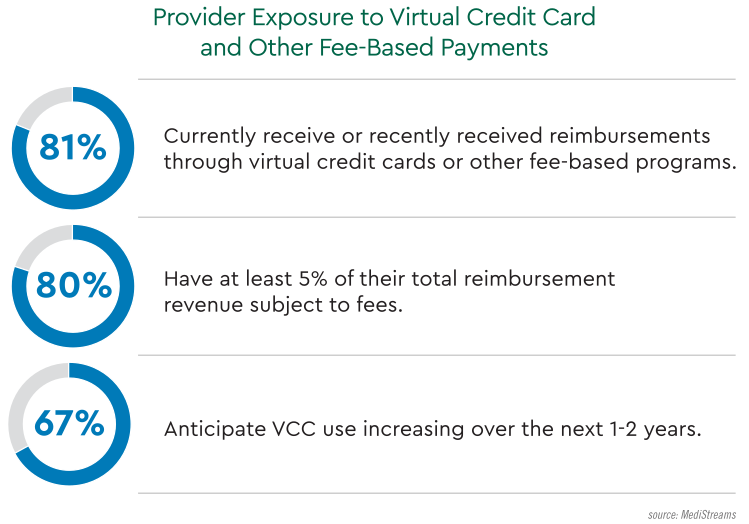
Figure 9
View PDF of Figure 9 opens in a new windowPDF- Support for process standardization efforts. Remittance automation systems dovetail with provider strategies to achieve overall RCM standardization on digital solutions.
- Future readiness. As healthcare changes, organizations need platforms that strengthen their ability to adapt successfully.
Conclusion: Follow the rights.
The urgency for RCM improvement is mounting, and the opportunity to capture productivity gains is substantial. Remittance automation offers a demonstrated path to value. Guided by the three “rights” of functionality, people, and platform, organizations can implement a solution that unlocks that value, bolsters their digital strategies, and positions them well to realize benefits from rapidly unfolding business and technology developments.
CommerceHealthcare® solutions are provided by Commerce Bank.
Disclosures:
[1]American Hospital Association, “Costs of Caring,” March 11, 2026.
[2]Deloitte, “How Health Care CFOs Can Adapt to Emerging Industry Conditions,” June 24, 2025.
[3]Symplyr, Compass Survey Report 2025, September 3, 2025.
[4]CAQH, 2025 CAQH Index, February 19, 2026.
[5]Ibid.
[6]CAQH, 2024 CAQH Index, February 12, 2025.
[7]CAQH, 2025 CAQH Index, February 19, 2026.
[8]A. Kacik, “Hospitals Tackle the Surge of Self-Pay Patients,” Modern Healthcare, December 2025.
[9]McKinsey & Company, The State of Organizations 2026, February 2026.
[10]Guidehouse, “Balancing Technology and Talent in Revenue Cycle Transformation,” January 22, 2026.
[11]Kaufman Hall, “2025 Health System Performance Outlook,” December 2025.
[12]KLAS, “Navigating the Uncertainty of Federal Policy 2025, July 2025.
[13] HealthLeaders, “Strategic Caution and Financial Realism Define the 2025 Healthcare M&A Landscape,” June 2025.
[14]Vizient Research Institute, “The Chronic Care Reckoning: Redesign or Absorb the Cost,” March 3, 2026.
[15]Zion Market Research, Digital Payment in Healthcare Market Size, Share, Trends, Growth and Forecast 2034, September 2025.
[16]Mordor Intelligence, Payment Orchestration Market Size and Share, July 2025.
[17]MediStreams, “New Research Reveals Virtual Credit Card Fees are Quietly Eroding Healthcare Provider Margins,” January 14, 2026.