
Key takeaways:
- As healthcare affordability concerns grow, flexible patient financing programs with personalized repayment options and transparent terms can help patients access care while supporting provider goals.
- Effective financing solutions combine technology integration, automated workflows, digital payment capabilities, and streamlined enrollment to reduce administrative burden and improve patient satisfaction.
- Long-term program success depends on aligning with financially strong organizations that offer healthcare experience, direct accountability, consistent administration, and proactive program oversight.
What characteristics define a highly productive relationship between healthcare organizations and patient financing providers?
That question is timely in light of the recent recognition of CommerceHealthcare® as the top Patient Financing and Payment Plan Platform in the 2026 Black Book Revenue Cycle Management (RCM) Technology & Services Report. This annual survey from Black Book Research gathers evaluations from more than 1,300 healthcare industry respondents, including hospital CFOs, revenue cycle leaders, patient financial services executives and technology decision-makers. The ranking represents another accolade for Commerce Bank, which has over 160 years of helping individuals and businesses through high-touch service and sophisticated, personalized financial solutions.
This CommerceHealthcare® Solution Perspective mines the bank’s experience to highlight the features and practices of patient financing that providers should seek to promote sustained program success.
Financing and the affordability challenge.
Patient financing is a high priority as providers face growing and urgent concerns about healthcare affordability. “Today, what matters most to consumers is whether a needed service is accessible and affordable, and what their out-of-pocket responsibility will be,” observed a noted industry policy analyst and commentator.[1] footnote [1] A nationwide poll revealed that 32% of respondents are very worried about being able to afford healthcare, and another 34% are somewhat worried.[2] footnote [2] Further illumination on this subject can be found in the data and analysis presented in the CommerceHealthcare® report Addressing Persistent Patient Affordability Barriers.
In response to the affordability pressures, patient financial assistance has been expanding. Aggregate financing reached more than $18 billion in 2025, experiencing a 4.1% compound annual growth rate over the previous five years.[3] footnote [3] Strong demand will further stress organizations as they grapple with significant industry financial headwinds.
Building blocks of a financing solution.
Healthcare organizations require not just more financing, but also the right program and platform. They want to increase the scope of their financial help in ways that deliver positive patient experiences while minimizing costly staff time and effort.
Working with the right financial institution can help organizations achieve five important benefits:

Figure 1
Figure 1 Text-Friendly Version PDF opens in a new window[PDF]
- Consistency of program execution
- Flexibility to meet varied patient needs
- Scalability to support nearly all patients needing financing
- Productivity to reduce patient financing labor resource constraints
- Sustainability of program success
What to seek in a solution: program structure and management.
The Black Book ranking reflects the success that CommerceHealthcare® has had in patient financing. The bank’s experience with health systems, hospitals and practices using its Health Services Financing (HSF®) solution demonstrates that the best results are obtained when several fundamental characteristics are present:
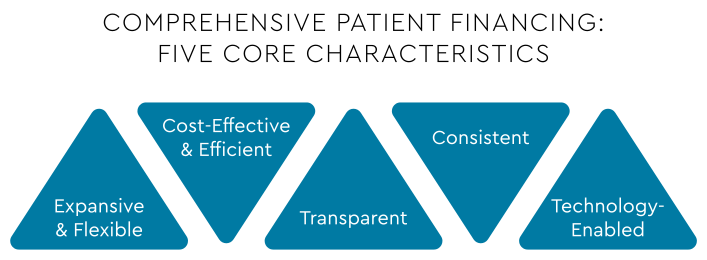
Figure 2
Figure 2 Text-Friendly Version PDF opens in a new window[PDF]
Expansive and flexible.
Each patient presents a unique financial profile. Payment plans must possess significant flexibility to manage the variety of scenarios. A proven practice involves no- or low-interest lines of credit with durations up to several years and dollar amounts that can reach $50,000. This approach maximizes the ability to personalize assistance and structure comfortable repayment schedules.
Patients can also tap unused portions of the credit line without undergoing new loan origination in the event that a subsequent medical expense occurs.
Cost-effective and efficient.
A recourse-based bank credit line features approval with no credit check in most cases. The provider doesn’t incur the staff cost and time burden of screening patient profiles and selecting candidates to be referred for the financing.
Transparent.
Healthcare organizations are increasingly offering patients pricing information in advance of service. A comprehensive financing program leverages this trend by including the option to extend credit lines based on the estimated charges. That can give patients the peace of mind needed to proceed with their treatment. A transparent financing program will also avoid hidden origination or other fees.
Consistent.
The external financing provider must be skilled at disciplined loan administration and patient relations. Processes should be clear and repeatable. Proficient management fosters participation and conveys a positive external image for the organization.
Technology-enabled.
The technology foundation for a strong patient financing platform rests on several pillars. Today’s solutions must integrate with the provider’s core financial, patient management, and electronic health record systems for data sharing and payment reconciliation. They must also support mobile devices, payment automation software, and a variety of digital payment methods gaining favor with consumers.
The platform also can’t be static. It should accommodate emerging developments such as near real-time transparency technology that promises rapid and accurate preservice estimates.
A program management illustration: the enrollment process.
Understanding how the five characteristics above combine effectively can be gleaned by reviewing the enrollment process. The HSF® approach blends automation and human touch to optimize onboarding and servicing in a structured, streamlined sequence.
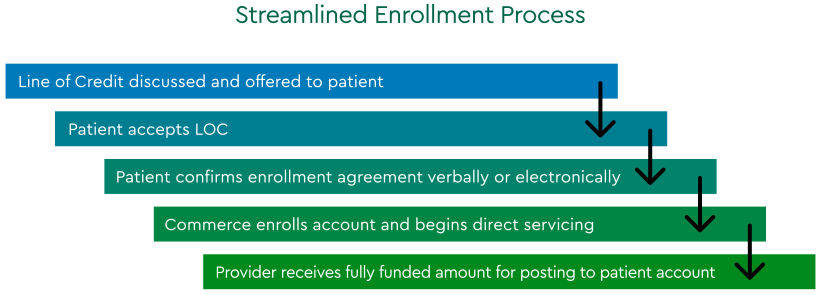
Figure 3
Figure 3 Text-Friendly Version PDF opens in a new window[PDF]
This process is designed for convenience. HSF® supports direct enrollment online, by phone or in-person. The bank can also work with an organization’s “early out” vendors. Patient, guarantor, and family billing can be accommodated. With no credit check required, costly paper-based workflows are avoided.
The result is a “no hassle” customer experience. Patients gain fast approval and enrollment, and the organization receives the full funding up front.
What to seek in a patient financing organization.
In addition to selecting an outsourced patient financing provider based on the program management strengths described, organizations also seek a set of vendor qualities. CommerceHealthcare® emphasizes the following as vital to success:
- Financial strength. Having the resources to provide flexible financing at scale is essential and minimizes risk for providers. For example, Commerce Bank® is one of the nation’s leading banks link opens in a new window, providing the financial strength and stability organizations expect.
- Deep healthcare industry experience. It’s important that a bank bring a thorough understanding of the industry’s relevant regulations and unique demands. This quality is particularly important today, given the need to navigate healthcare’s many uncertainties and fast-changing trends.
- Dedicated healthcare bankers. Unlike many financial institutions, client relationship managers at CommerceHealthcare® solely focus on healthcare. That avoids dilution of effort and knowledge arising from covering multiple industries.
- Single-vendor responsibility. Many financing vendors rely on third parties to execute crucial steps in the overall process. CommerceHealthcare® believes this introduces risk and prefers to maintain control and accountability for its clients. The bank directly manages all compliance requirements with consumer lending laws.
- Commitment to diligence. Sustaining program excellence is vital. That requires steady surveillance of processes and client strategies, quarterly and annual reviews, and willingness to propose course adjustments that can benefit the patient and provider. The financial institution should be an advisor as well as a vendor.
Conclusion.
With patient financing assuming ever greater importance, health systems, hospitals and practices need help providing a robust, scalable program. As evidenced by Black Book’s recognition of the CommerceHealthcare® solution, organizations can look for a distinct set of characteristics in a bank to achieve their goals. The benefits of doing so are significant for providers and patients alike.
CommerceHealthcare® solutions are provided by Commerce Bank.